
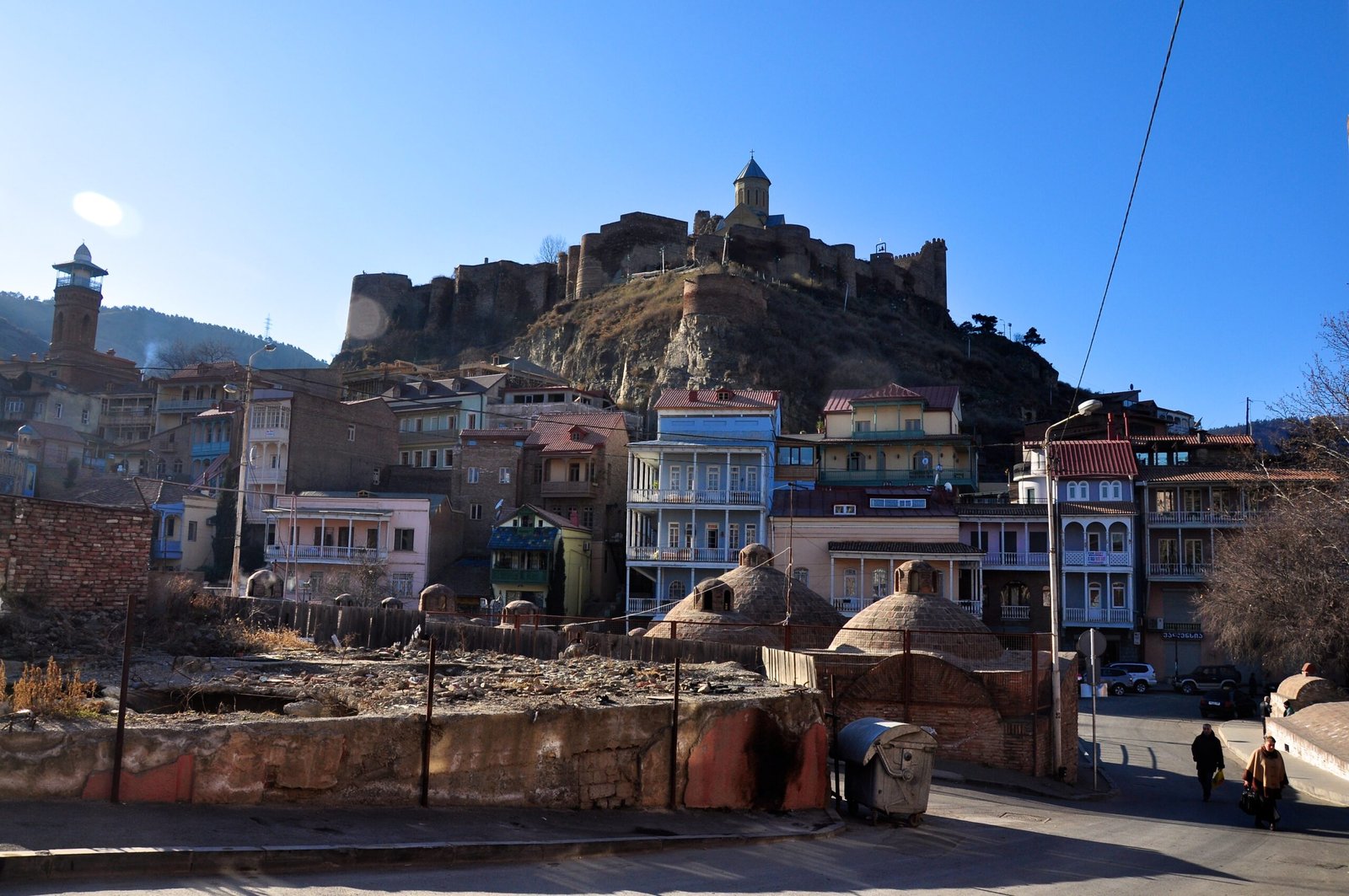
Quick answer: Tbilisi rewards wandering more than checklist sightseeing — the Old Town, sulfur bath district (Abanotubani) and Narikala Fortress sit within a 20-minute walk of each other. The cable car up to Narikala costs a token 2.5 GEL but only accepts the local Metromoney transit card, not cash or standard bank cards — buy one at the Rike station kiosk first. For where to stay, Sololaki and Vera are the best base for a first visit; Vake and Saburtalo are better for longer stays.
Table of contents
Old Town and Narikala Fortress
Tbilisi’s Old Town (Kala) is compact enough to explore without a fixed itinerary — half a day of genuinely getting lost among the winding streets is, honestly, the best way to see it. Key stops include the 6th-century Anchiskhati Basilica, the 13th-century Sioni Cathedral, and the Rezo Gabriadze Puppet Theatre, whose clock tower puts on a small mechanical show on the hour.
Above it all sits Narikala Fortress, dating in parts to the 4th century. It’s undergone periodic restoration, so don’t be surprised if a section is fenced off when you visit — check recent visitor reports before planning around a specific viewpoint. The cable car from Rike Park is the easiest way up: it costs 2.5 GEL one-way but runs on a closed payment system — you’ll need a Metromoney card (available at the Rike station, metro stations, or yellow kiosks around the city) since cash and ordinary bank cards aren’t accepted at the cabin itself. One card covers multiple riders, so a group only needs one. The cable car typically runs from around 11:00 to 23:00 depending on season, and closes temporarily in strong wind or thunderstorms.
The sulfur baths of Abanotubani
Just below Narikala, the domed bathhouses of Abanotubani draw on natural sulfur springs that reach 40–47°C. You have two real options: a communal public pool, typically 5–10 GEL, or a private room booked by the hour, generally 50–150 GEL depending on the bathhouse and room size. Private rooms usually include the sulfur pool itself, a steam room, and the option to add a scrub-and-massage treatment (kisi) for an extra fee. Either way, book private rooms ahead on weekends — they fill up.
Where to stay: neighborhood by neighborhood
| Neighborhood | Character | Best for |
|---|---|---|
| Old Town (Kala) | Historic, atmospheric, touristy and pricier | Being in the middle of everything |
| Sololaki | Elegant 19th-century Art Nouveau buildings, trendy cafes | First-time visitors wanting character + walkability |
| Mtatsminda / Rustaveli area | Museums, parliament, opera house, parks | Culture-focused first visits |
| Vera | Hip, upmarket, wine bars and specialty coffee | First-time visitors who want a contemporary feel |
| Vake | Green, family-friendly, “posh suburb” | Longer stays, quieter pace |
| Chugureti | Creative, edgy, nightlife (Fabrika complex) | Younger travelers, nightlife |
| Avlabari | Former Armenian quarter, Sameba Cathedral nearby | Budget stays, fewer restaurants nearby |
| Saburtalo | Soviet-era, budget-friendly, student/expat area | Longer stays on a budget, less central |
Getting around
The Metromoney card mentioned above for the cable car also works across Tbilisi’s metro and bus network, so it’s worth picking one up on arrival regardless of whether you plan to ride the cable car. Central Tbilisi is very walkable; save the metro for longer hops like getting to Saburtalo or the airport area.
FAQ
Can I pay cash for the Narikala cable car?
No — it only accepts the Metromoney transit card. Buy one at the Rike Park station or a metro station before you queue.
Which neighborhood should a first-time visitor pick?
Sololaki or Vera — both put you within easy walking distance of the Old Town, Narikala, and good restaurants.
Are the sulfur baths worth it?
Yes — a private room (50-150 GEL) is a genuinely relaxing, distinctly Tbilisi experience, and worth booking ahead for weekend visits.
Photo: Simon, CC BY-SA 2.0, via Wikimedia Commons.