
In short
Bulguksa and Seokguram have been free since 4 May 2023 — most guides still quote ₩6,000. Gyeongju is touched by four separate UNESCO inscriptions, and Bulguksa is not part of the Gyeongju Historic Areas listing. Daereungwon and Cheomseongdae are free; Cheonmachong and Wolji Pond are ₩3,000 each. It is 30 minutes from Busan by KTX — but stay a night for Wolji after dark.
Checked 27 August 2026 against Gyeongju city’s official admission page and UNESCO inscription records.
On this page
Two things about Gyeongju that most English-language travel writing gets wrong.
Bulguksa and Seokguram have been free to enter since 4 May 2023, when Korea waived the cultural-property admission fee at Jogye Order temples. A great deal of writing still quotes ₩6,000. And Gyeongju is not covered by one UNESCO inscription, or two — it is touched by four, and Bulguksa is not part of the one everybody names.
Here is the accurate version, checked on 27 August 2026.
What Gyeongju was
Capital of the Silla kingdom from 57 BC to 935 AD — 992 years, so “roughly a thousand” is honest and the precise figure is better.
At its height in the seventh to ninth centuries, Silla ruled about two-thirds of the peninsula and this city held an estimated 800,000 to 900,000 people, which made it the fourth-largest city in the world.
It is genuinely called “the museum without walls,” and that is a documented epithet rather than a copywriter’s invention: the tombs and temples are simply distributed through an ordinary working town.
The UNESCO listings, precisely
1. Gyeongju Historic Areas — inscribed 2000, criteria (ii) and (iii). This is five separate belts, not one site: the Mount Namsan Belt, Wolseong Belt, Tumuli Park Belt, Hwangnyongsa Belt and Sanseong Fortress Belt. Note the naming trap — UNESCO’s “Tumuli Park Belt” is what the city calls the Daereungwon district. Same place.
2. Seokguram Grotto and Bulguksa Temple — inscribed 1995, five years earlier, criteria (i) and (iv). This is a separate inscription. Bulguksa and Seokguram are not part of the Gyeongju Historic Areas listing, and writing that says otherwise is wrong. Bulguksa was built in 774.
3. Historic Villages of Korea: Hahoe and Yangdong — inscribed 2010. Yangdong is administratively part of Gyeongju, not merely near it. Hahoe is 90 km away in Andong.
4. Seowon, Korean Neo-Confucian Academies — inscribed 2019. Nine academies, of which Oksan Seowon is in Gyeongju.
The city itself counts eight World Heritage areas within its boundaries. That is a remarkable concentration and nobody writes it accurately.
Admission and hours
From the city’s own official admission page:
| Site | Adult | Youth | Child |
|---|---|---|---|
| Bulguksa | Free since 4 May 2023 | Free | Free |
| Seokguram | Free since 4 May 2023 | Free | Free |
| Daereungwon park entry | Free | Free | Free |
| Cheonmachong (the opened tomb inside it) | ₩3,000 | ₩2,000 | ₩1,000 |
| Donggung Palace and Wolji Pond | ₩3,000 | ₩2,000 | ₩1,000 |
| Cheomseongdae | Free | Free | Free |
| Poseokjeong | ₩2,000 | ₩1,000 | ₩500 |
| Yangdong Village | ₩4,000 | ₩2,000 | ₩1,500 |
| Hwangnyongsa History Culture Hall | ₩3,000 | ₩2,000 | ₩1,500 |
Also free: the Gyeongju National Museum’s permanent galleries, Bunhwangsa, Tongiljeon and the Munmu Underwater Tomb. Under-6s and over-65s go free everywhere, as do Gyeongju residents.
Parking is still charged at Bulguksa and Seokguram even though entry is not.
One honest caveat, and the city prints it itself: temple and museum fees and hours can change, and the temples are administered separately from the city. Check on the day if it matters.
What to actually see
Daereungwon is the tumuli park — grassy burial mounds the size of small hills, in the middle of town, free to walk among. Cheonmachong is the one tomb you can go inside, for ₩3,000, and it is worth it.
Donggung Palace and Wolji Pond is the one to do at night. The reconstructed pavilions reflected in the pond after dark is the image of Gyeongju, and the ₩3,000 buys the same ticket either way.
Cheomseongdae, free and floodlit, is a stone observatory from the seventh century and among the oldest surviving astronomical structures anywhere.
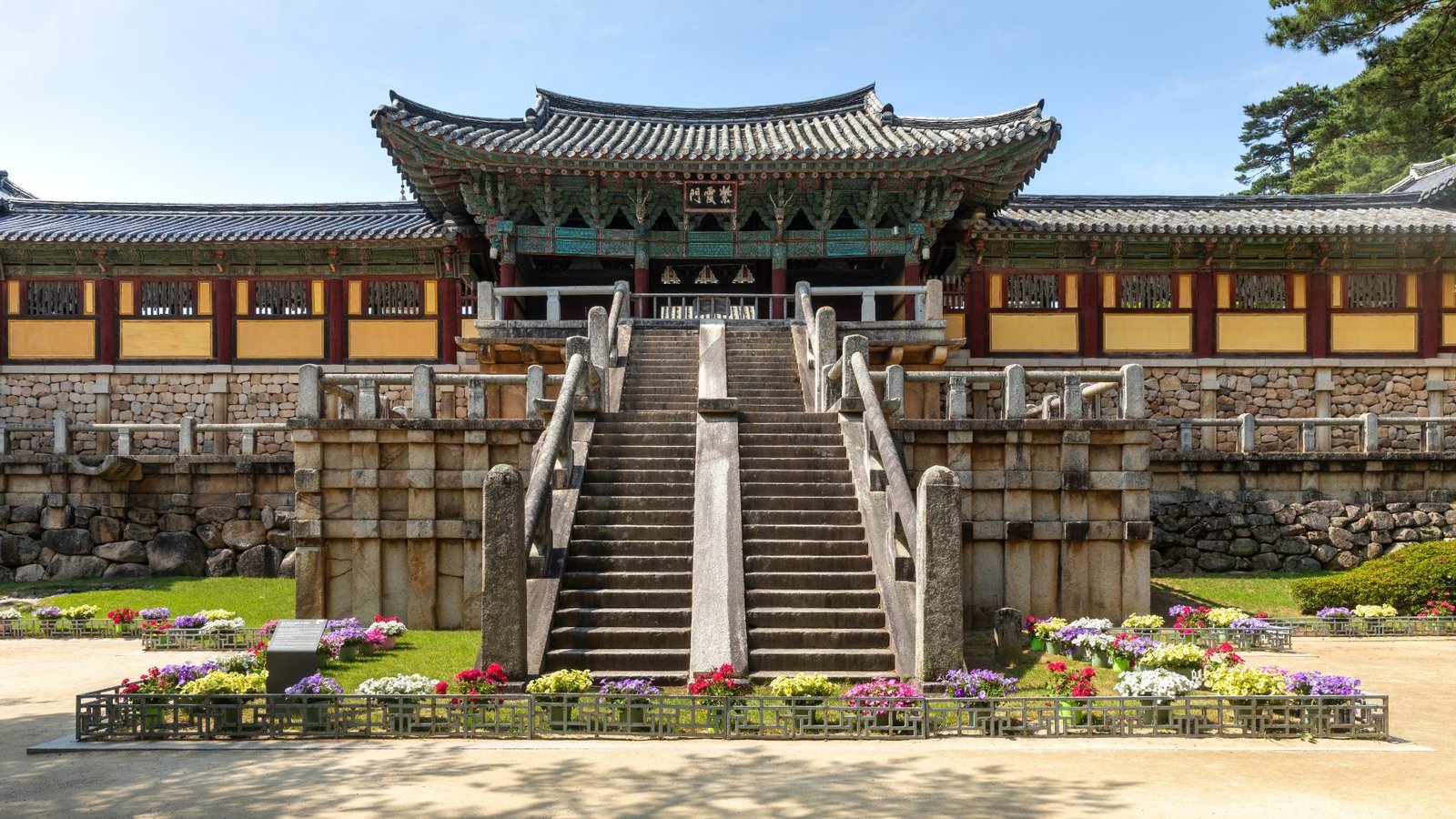
Bulguksa is the great Silla temple, terraced up a hillside on stone platforms from 774. Seokguram, above it, is a granite grotto holding a seated Buddha looking east toward the sea — UNESCO calls it a masterpiece of East Asian Buddhist art. They are a short bus ride apart and both now free.
Namsan is the mountain south of town, carved and studded with Buddhist reliefs, pagodas and temple remains across its whole surface. It is one of the five inscribed belts and it is where you go if you want the archaeology without the crowds.
Yangdong Village is a working 15th-century clan village, ₩4,000, and a genuine detour rather than a stop.
Getting there and around
Seoul to Singyeongju is about two hours ten minutes by KTX. From Busan it is only 30 minutes, or 50 to 70 minutes by bus, which makes it a very realistic day trip — see our Busan guide.
Note the station: Singyeongju is out of town, and you take a local bus or taxi into the centre. The historic core is not at the KTX station.
Cycling is the standard recommendation and it is a sound one — the central sites, the tumuli, Cheomseongdae and Wolji are close together across flat ground, and rental is widely available near the station and the bus terminal. We could not confirm current rental prices.
How long, and should you day-trip it?
Two days, one night. The reason is Wolji Pond after dark, and it is a good reason — a day trip from Busan gets you back on a train before the thing you came for is at its best.
If you only have a day, come from Busan rather than Seoul, do Bulguksa and Seokguram in the morning and the central cluster in the afternoon, and accept that you are missing Namsan and the night view.
When to go
Gyeongju is famous for cherry blossom, and its timing runs close to Busan’s rather than Seoul’s — the south blooms first, typically in the last days of March. Seoul’s own normal is 8 April, but recent years have run consistently earlier, so plan for late March to mid-April and watch the private forecasters from mid-March.
Autumn colour peaks in late October and moves north to south, so Gyeongju turns after Seoul does.
Both peaks bring domestic crowds. The tumuli park in blossom is one of the more photographed places in Korea, and it is not a quiet experience.
Where to stay
Gyeongju has a good stock of hanok guesthouses in and around the Hwangnidan-gil area near Daereungwon, which is also where the cafés and restaurants have concentrated in recent years. It is walkable to almost everything central.
We are not naming individual properties — we could not confirm current operation or 2026 rates for the ones commonly recommended, and we would rather give you the area than a list that might be stale.
What we could not verify
Current bicycle rental prices. Current accommodation rates and named properties. Whether anything built for the APEC 2025 summit, which Gyeongju hosted, has changed the visitor infrastructure — we could not establish what was built or what remains. And a current visitor-number figure; the ones in circulation appear to predate 2020.
On the Bulguksa and Seokguram fee waiver: two independent sources agree and both cite the culture ministry’s policy, but we could not reach a primary government or temple page to confirm it. It is very likely correct — the policy waived these fees nationally at Jogye Order temples — but if you are budgeting tightly, carry the ₩6,000 just in case.
For the wider trip, see our South Korea transport guide.
Photo: Bulguksa temple entrance gate stairs flower bed and blue sky in Gyeongju South Korea by Basile Morin, via Wikimedia Commons, CC BY-SA 4.0.