
In short
Manjanggul reopened on 30 May 2026 — ₩4,000, closed the first Wednesday monthly. The two Hallasan summit trails require a free reservation booked at visithalla.jeju.go.kr, with the window opening on the 1st of each month; no-shows get a three-month ban. The Busan–Jeju ferry ended in 2022. Car hire needs an original passport and original IDP — no photocopies. October is the safest month.
Checked 27 August 2026 against the Hallasan reservation portal, VisitKorea, UNESCO records and Jeju Tourism Association statistics.
On this page
Manjanggul lava tube reopened on 30 May 2026, after two and a half years closed following a rockfall. Most guides still say it is shut.
And if you intend to climb Hallasan to the summit, you need a free advance reservation, the booking window opens on the first of each month, and turning up without one gets you a three-month ban rather than a shrug.
Here is Jeju as it currently is, checked on 27 August 2026.
Getting there
Gimpo to Jeju is the busiest air route in the world — 14.4 million scheduled seats in 2025, ranked first globally, about 39,000 seats a day. That is seats scheduled, not passengers flown, and the distinction matters if you see the figure quoted elsewhere.
Eight carriers fly it domestically. Note that Korean Air’s absorption of Asiana is completing through 2026 and the three low-cost subsidiaries are merging, so the carrier list is in flux.
The ferries have changed and one popular route no longer exists. The Busan–Jeju ferry ended in December 2022 and has no successor; Yeosu–Jeju closed in December 2024. What remains:
| Route | Duration | Frequency |
|---|---|---|
| Wando – Jeju | ~2h 40m | 3 daily |
| Nokdong – Jeju | ~3h 40m | 6 weekly |
| Mokpo – Jeju | ~4h 30m | 3 weekly |
| Jindo – Jeju (catamaran) | ~1h 30m | — |
Jindo is fastest and the first to be cancelled when the sea gets up.
The three UNESCO designations, kept straight
Jeju holds all three natural UNESCO designations — sometimes called the triple crown — and travel writing routinely muddles them.
- Biosphere Reserve — 2002. Covers the whole island, 387,194 hectares including marine area.
- World Heritage: “Jeju Volcanic Island and Lava Tubes” — 2007, criteria (vii) and (viii), both natural. It covers exactly three components: the Geomunoreum lava tube system, Seongsan Ilchulbong tuff cone, and Hallasan. Not the whole island.
- Global Geopark — 2010. Island-wide.
Only the World Heritage listing is limited to specific sites. The other two cover everything.
Hallasan, and the reservation you must not skip
The mountain is 1,947 metres — South Korea’s highest — and it has five main trails, but only two reach the summit:
| Trail | Length one way | Summit? |
|---|---|---|
| Seongpanak | 9.6 km | Yes — the gentler route |
| Gwaneumsa | 8.7 km | Yes — shorter, considerably steeper |
| Eorimok | 4.7 km | No — Witse Oreum only |
| Yeongsil | 3.7 km | No — Witse Oreum only |
| Donnaeko | 9.1 km | No |
The upper sections of the three non-summit trails have been closed since 1994 for vegetation recovery.
The reservation system applies only to the two summit trails, and it is free. Book at visithalla.jeju.go.kr. The booking window opens on the 1st of each month, covering the remainder of that month plus all of the following one.
No-shows are penalised: a three-month ban for a first offence, a year for a second. Staff check your reservation against a list at the gate; an email confirmation, app screenshot or printout all work.
Individual trails do get restricted independently — when we checked, Seongpanak showed normal operation while Gwaneumsa showed a reservation restriction. Check your specific trail.
Seongpanak is eight to nine hours round trip with about 1,300 metres of gain. There are also enforced turnaround cut-off times at the shelters, which vary by season and are applied regardless of your reservation — sources disagree on the exact times, so get yours from the official site for your date. There are no shops on the mountain.
Getting to the trailheads: bus 281 to Seongpanak roughly every 14 minutes, or 182 and 182-1 every 40; bus 475 to Gwaneumsa, hourly.
Manjanggul is open again
Closed since a rockfall in December 2023, reopened 30 May 2026 with new observation decks and LED lighting.
About 1 km of the 7.4 km tube is open. Hours 09:00–18:00 with last admission around 17:10, closed the first Wednesday of every month. Adults ₩4,000, teenagers and children ₩2,000, under-6s free. Inside is a 7.6-metre lava column, reportedly the largest in the world.
The rest of the island
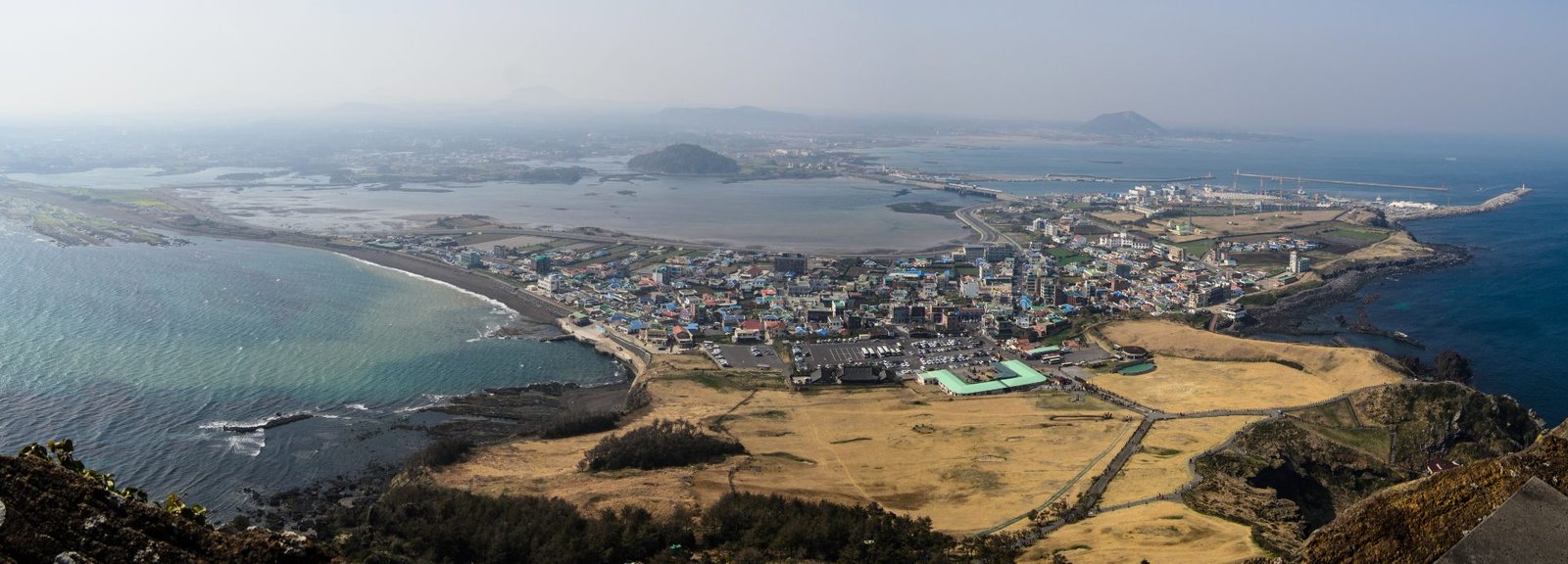
Seongsan Ilchulbong — a tuff cone formed by an underwater eruption about 6,700 years ago, 182 metres high, roughly 30 minutes up a wooden stairway. It opens an hour before sunrise and closes at 20:00 from November to February, 21:00 from March to October. It is the classic first-sunrise-of-the-year spot in Korea.
Udo — the small island off the east coast. Ferry from Seongsan Port, about 15 minutes, every 20 to 30 minutes at peak, ₩8,500–9,000 return plus a separate island entry fee. There is no public transport on Udo; you rent a bicycle, e-bike, scooter or electric buggy near the terminal for ₩15,000–30,000. Budget ₩50,000–80,000 a head all-in.
The Jeju Olle Trail is 27 routes over 437 km — 21 forming a connected loop of the main island and six on smaller islands. Blue arrows run clockwise, orange counter-clockwise, and you can walk either way. There is a stamp passport, ₩20,000 on paper or free in the app, with a certificate for completing the set. Route 7 changed significantly in 2026 because of road construction.
The haenyeo, honestly
The women free-divers of Jeju were inscribed on UNESCO’s intangible heritage list in 2016, and the honest version of their story is a demographic one.
There are 2,838 divers on Jeju, and 90.3 per cent of them are over 60. Only 99 are under 50 — six under 30, 27 in their thirties, 66 in their forties. The province now pays women aged 40 to 44 a settlement of ₩500,000 a month for three years, plus association fees and healthcare, to try to recruit.
Diving runs roughly early May to the end of October, on the eastern and western coasts and particularly around Hado. Sightings depend on tide and weather rather than a schedule — this is work, not a performance.
Getting around
The island works far better with a car, and hiring one has a hard requirement most visitors do not expect. You need your original passport and an original International Driving Permit — photocopies and PDFs are refused. The IDP must come from a Geneva or Vienna Convention signatory; permits from private organisations are invalid. It is valid one year from your date of entry into Korea, and drivers must be 21 to 79.
Without a car: Limousine Bus 600 runs from the airport to Seogwipo for about ₩4,700, every 15 to 20 minutes from 06:20 to 21:50. City buses are ₩1,000–1,500. A taxi from the airport is ₩8,000–12,000 into Jeju City but ₩45,000–60,000 to Seogwipo, 50 to 70 minutes.
Jeju City or Seogwipo? The airport is in Jeju City on the north coast; Seogwipo is on the south, warmer, quieter, and closer to the waterfalls and the Olle routes people actually walk. If you are staying put, Seogwipo. If you are moving daily, Jeju City.
When to go
October is the safest month — outside both the July monsoon and the typhoon window.
Typhoon risk runs late August through September, peaking in early to mid-September. When weather comes in, things cancel in a predictable order: the islet ferries go first — Udo, Gapado, Marado — then flights, then the Hallasan summit trails, which close on a typhoon warning regardless of your reservation. Book refundable rates if you are travelling in that window.
Two things you will read that are not true yet
The second airport has not been built and will not be soon. It is in environmental impact assessment, not construction — field surveys began in August 2025, the assessment needs a minimum year of seasonal data, and the full process including hearings runs about two years. Nothing to plan around before the 2030s. The old official line about opening in 2025 is long dead.
The tourist tax has not been enacted. A levy of ₩1,500 per person per night plus vehicle charges has been proposed — most recently in the mid-2020s, and repeatedly since 2012 — and it is still not law. There is nothing to pay on arrival.
A number worth knowing
Jeju took 6,765,358 visitors in the first half of 2026. In June alone the total fell 6.6 per cent year on year — but that hides a split: domestic visitors down 10.2 per cent, foreign visitors up 8.7 per cent.
Jeju is getting less Korean and more international, which is worth knowing if you have heard it described as a domestic holiday island.
What we could not verify
Typical fares from Seoul or Busan. Named hotels and restaurants with current prices — we would rather name none than name a closed one. Details for the Jeongbang and Cheonjiyeon waterfalls and Bijarim forest. The Haenyeo Museum’s hours and admission. The date and structure of Jeju’s bus reform. And whether Udo genuinely bans tourist rental cars, which is widely reported and which we could not confirm.
For the mainland, start with our South Korea transport guide.
Photo: Panorama from Seongsan Ilchulbong (성산 일출봉) – Flickr – mrmin123 by Minyoung Choi from Cupertino, CA, USA, via Wikimedia Commons, CC BY-SA 2.0.