
In short
Gamcheon Culture Village has been a designated special management area since 1 August 2026 — tourist vehicles banned from the main street, residential lanes restricted after 18:00, and it opens 09:00–18:00, not 24 hours. The Sky Capsule is priced per capsule one way (₩40,000–50,000), with no return ticket. Seoul–Busan KTX is now ₩54,400. Busan needs three days.
Checked 27 August 2026 against Visit Busan, VisitKorea, operator fare pages and Korean reporting of the Gamcheon designation.
On this page
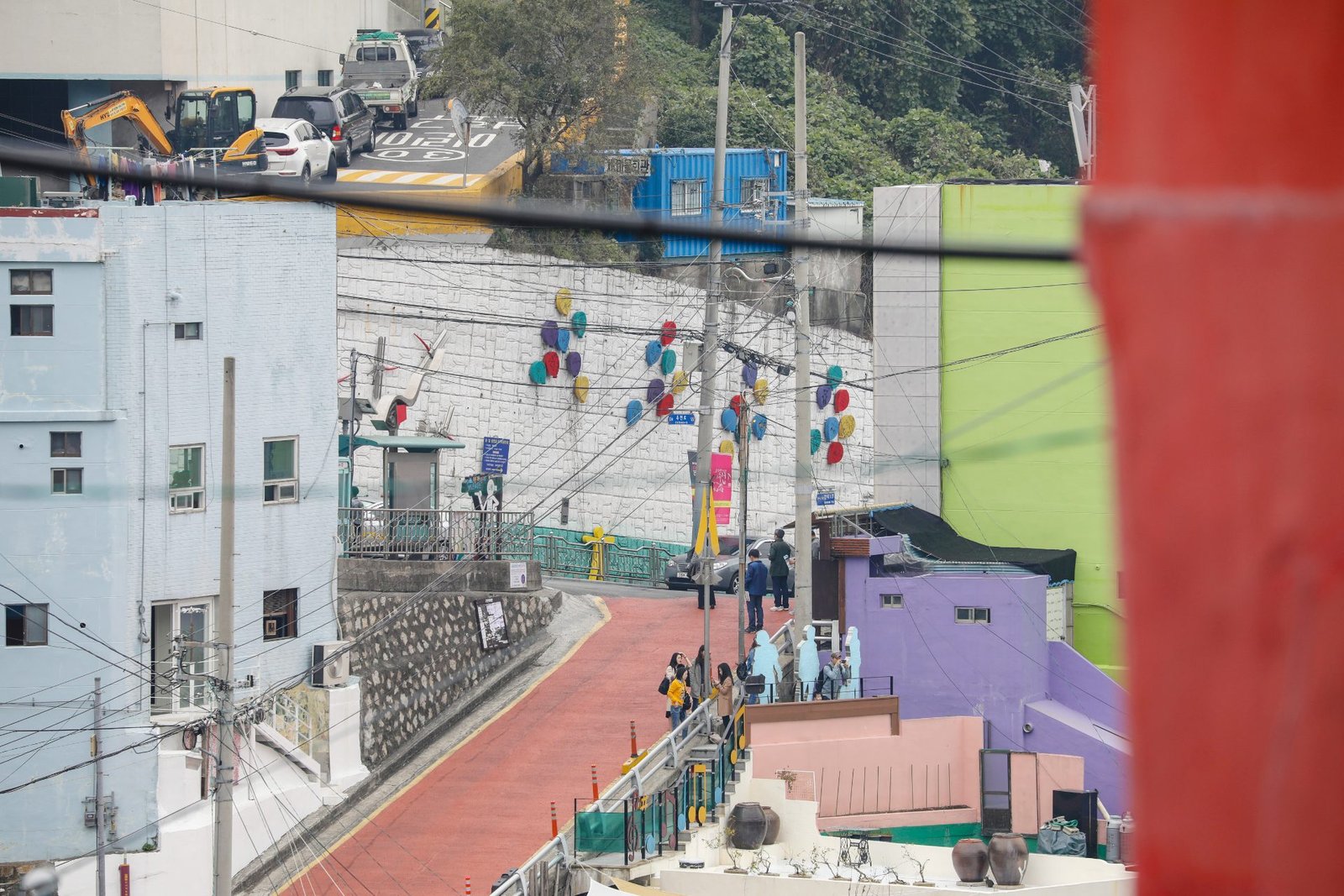
Gamcheon Culture Village became a legally designated tourism “special management area” on 1 August 2026. Tourist vehicles and taxis are now banned from its main street, marshals with whistles control the entry points, access to residential lanes is restricted after 18:00, and tour groups of ten or more must buy guide maps.
It is Korea’s third such zone, after Bukchon in Seoul and Hantangang. If you have read that Gamcheon is a free-for-all hillside of painted houses, that was true and is not any more.
Here is Busan as it currently works, checked on 27 August 2026.
Getting there — and the fare just changed
Seoul to Busan by KTX is ₩54,400 and takes about two and a half hours. That fare took effect on 1 September 2026, when KORAIL absorbed SRT and cut prices by around ten per cent. Guides quoting ₩59,800 are describing the pre-September fare — including several updated as recently as mid-2026.
Departures now run from Seoul Station, Yongsan and Suseo, which was SRT’s terminal and is now simply another KTX station. Our South Korea transport guide covers the merger in full.
The express bus is roughly ₩23,600–28,600 and takes four to five hours. It saves about ₩30,000 and costs two and a half hours.
Gamcheon, and how to visit it decently
Admission is free. Hours are 09:00–18:00 from March to October and 09:00–17:00 from November to February — note that one official tourism site still says “open 24 hours,” which is no longer consistent with the access rules.
Getting there: from Goejeong station (Line 1, Exit 6) take village bus Saha 1 or Saha 1-1 to Gamjeong Elementary School, then walk five minutes. From Toseong station (Line 1, Exit 6) take Saha 1-1, Seo-gu 2 or Seo-gu 2-2 to the same stop.
The stamp map is real and bought at the information centre; the price is not published. Drones are banned by the residents’ council.
Now the part worth saying plainly. About 5,000 people live here. Visitor numbers ran to roughly 3.1 million last year with 4 million projected for 2026 — that is 800 visitors per resident. Residents report tourists opening their gates and photographing their laundry; one woman in her seventies told a reporter she keeps her doors and windows shut through the summer.
The authorities deliberately chose not to charge admission, using time and vehicle restrictions instead. So the way to visit well is straightforward: come inside the hours, stay out of the residential lanes, do not photograph into people’s homes, and keep your voice down. It costs you nothing and it is the whole difference between being a visitor and being a problem.
The rest of the sights, with the details that catch people out
Haedong Yonggungsa — free, open 04:30 to 19:20 with last admission 18:50. Founded in 1376 and unusual in Korea for being a coastal temple rather than a mountain one. Go early; it is spectacular and it fills.
Jagalchi Market — 05:00 to 22:00, and closed on the first and third Tuesday of each month. That closure catches people out constantly.
Gukje Market — 09:00 to 20:00, closed Sundays, individual shops varying.
Beomeosa Temple — free, 08:00 to 17:00, founded in 678 under Silla. Templestay programmes run here, and it is the better temple if you want quiet.
Taejongdae — the Danubi Train around the headland costs ₩4,000 return for adults, ₩2,000 one way, ₩1,500 for children. It runs 09:20–18:30 from June to September and to 17:30 otherwise, and is closed on Mondays and in bad weather.
Haeundae Blueline Park — the one everybody wants, and the pricing is misunderstood. The Sky Capsule is priced per capsule, one way, not per person:
| Capsule | One way |
|---|---|
| 2-seater | ₩40,000 |
| 3-seater | ₩45,000 |
| 4-seater | ₩50,000 |
There is no round-trip Sky Capsule ticket — you buy a second one-way or ride the Beach Train back. Combined packages of one-way capsule plus all-station Beach Train run ₩65,000 for two, ₩78,000 for three, ₩94,000 for four. The Beach Train alone is ₩10,000 for adults, ₩7,000 for children, from Mipo or Songjeong.
It sells out. Book ahead.
The Visit Busan Pass, and whether it pays
Four products: 24-hour and 48-hour time-limited passes, and BIG3 and BIG5 quantity-limited passes valid 180 days from activation. Foreign nationals only. The official site says around 30 facilities are free, with discounts at 160-plus more.
The single most misreported detail: the physical card doubles as a transport card for subway, bus and taxi. The mobile QR version does not. If you want the transport function, you need the physical card.
Does it pay? Only if you stack paid attractions into one day. The best case someone has published stacks Lotte World Busan, Busan X the Sky and the Skyline Luge into ₩104,000 of admissions against a 24-hour pass — a real saving.
But the counter-case is the trip most people are actually taking. Gamcheon, Haedong Yonggungsa, Beomeosa, Jagalchi, Gukje and every single beach are free. If that is your Busan, the pass is money lost.
The sensible move: buy one 24-hour pass and time it to your most attraction-heavy day, rather than trying to cover the trip. And note the pass covers the Beach Train, not the Sky Capsule on the listings we could read.
We are not printing a price. Three sources gave three different figures and the official price page would not render — check visitbusanpass.com directly.
Where to base yourself
Haeundae — the big beach, the towers, the best hotel stock, and the Blueline Park terminus. Convenient and slightly generic.
Gwangalli — the better beach in our view: the bridge view at night is the image of Busan, and the bar and café strip behind it is more interesting than Haeundae’s.
Seomyeon — the commercial and transit heart, where the two subway lines cross. Not scenic, extremely practical.
Nampo-dong — the old downtown by Jagalchi and Gukje, and the base for Gamcheon. Our pick for a first visit.
Songjeong — small, surf-oriented, the other end of the Beach Train.
Food
Busan’s food is genuinely distinct from Seoul’s and it is the reason to eat out here rather than defaulting to the hotel. The city specialities: dwaeji gukbap, the pork and rice soup that is Busan’s signature dish; milmyeon, a wheat-noodle answer to naengmyeon born of Korean War shortages; ssiat hotteok, the seed-stuffed griddle pancake sold in Nampo-dong; and eomuk, the fish cake, which reaches an entirely different standard here.
We are not naming individual restaurants — we could not confirm current operation for the ones commonly recommended, and a closed restaurant in a guide is worse than no restaurant at all. Eat at Jagalchi, walk Nampo-dong, and follow queues.
Beaches and days
Haeundae, Gwangalli and Songjeong are the three you will hear about. Outside the official swimming season they remain pleasant to walk and are considerably nicer without the crowds — Gwangalli at night in October is one of the better free experiences in Korea.
How long does Busan need? Three days. One for Nampo-dong, Jagalchi and Gamcheon; one for the coast — Haeundae, Blueline Park, Haedong Yonggungsa; one for Beomeosa, Taejongdae and whichever beach you liked.
Gyeongju is 30 minutes away by KTX, or 50 to 70 minutes by bus, which makes it an entirely realistic day trip — though we would argue for staying the night, and explain why in our Gyeongju guide.
What we could not verify
Visit Busan Pass prices in won. The Gamcheon stamp map price. Current operation for individual restaurants. Whether the Gamcheon residential-access rule is enforced by fines or guidance — reporting differs. Official swimming season dates. And transport details for Tongyeong and Geoje.
One general warning for this destination: Sky Capsule fares are quoted differently across sources, including in Korean media. We have used the operator’s own fare page, read directly. If you see ₩50,000–60,000 quoted, that is not what the operator was publishing when we checked.
Photo: Gamcheon Culture Village Busan (44835444995) by bryan…, via Wikimedia Commons, CC BY-SA 2.0.