
In short
For a first visit, stay in Jongno or Insadong — walking distance to the palaces, on multiple subway lines, and a city that existed before 1980. Myeongdong is the safe answer, not the better one. Hostel dorms run ₩15,000–43,000, business hotels ₩80,000–200,000. Since 1 January 2026 unregistered properties are unbookable on Airbnb Korea, and since July 2026 hotels may not charge above their posted rate.
Checked 27 August 2026 against live booking inventory, property sites and Korean reporting of the 2025–26 licensing and pricing rules.
On this page
Two things changed about staying in Seoul that most guides have not caught up with.
Since 1 January 2026, unregistered properties are no longer bookable on Airbnb Korea — the platform now requires every host to hold a lodging licence. And since 16 July 2026, hotels must display their rates and may not charge above the posted price, with escalating suspensions for those that do.
Both are genuinely good news for visitors. Here is where to actually stay.
First, one hotel to strike off your list
THE PLAZA Seoul closes on 30 September 2026 for a full remodelling and does not reopen until 2029. It is a very widely recommended City Hall hotel and it is about to stop existing for three years. If you find it recommended somewhere, that page is stale.
The neighbourhoods
Myeongdong — the default first-timer choice, and defensible. Central, dense with shopping and street food, well connected, and touristed to the point of caricature. Good transport, poor atmosphere after the shops shut.
Jongno and Insadong — the old city. Palaces, tea houses, Gwanghwamun. This is where we would put a first-time visitor who wants to feel like they are in Seoul rather than in a shopping district.
Bukchon — the hanok quarter between the palaces. Beautiful, quiet, hilly, and residential enough that signs ask you to keep your voice down. Stay here for the setting, not for convenience.
Hongdae — the university district, and where Seoul is young and loud. Best hostel and budget stock in the city, live music, open late. If you want to sleep before 2am, do not stay on the main strips.
Mapo and Yeonnam — one subway stop out from Hongdae’s noise, with the same food and a fraction of the volume. Our pick for a repeat visitor.
Itaewon — international, diverse, the most non-Korean food in the city, and a nightlife scene. Hilly.
Gangnam — business Seoul: broad avenues, expensive hotels, good restaurants, no atmosphere to speak of. Excellent if you have meetings, unnecessary if you do not.
Seongsu — the converted-warehouse district, cafés and concept stores. Thin on hotels; expect serviced apartments.
Euljiro — print shops and machine works by day, some of the best bars in Asia by night. Thin on accommodation.
Yeouido — the finance island, and where the cherry blossom festival happens each April. Lines 5 and 9 meet at Yeouido station; Yeouinaru is on Line 5.
Dongdaemun — night markets and the Zaha Hadid design plaza. Convenient, unlovely.
Where should a first-timer actually stay? Jongno or Insadong. You are walking distance from the palaces, on multiple subway lines, and surrounded by a city that existed before 1980. Myeongdong is the safe answer; Jongno is the better one.
What it costs
Honest caveat first: Seoul accommodation pricing is poorly documented in English, and the ranges below come from a mix of live booking-platform data and dated guides. We have said which is which.
| Type | Nightly |
|---|---|
| Hostel dorm | ₩15,000–43,000 (live platform data) |
| Guesthouse private room | Typically undercuts a business hotel — roughly ₩40,000–80,000 |
| Business / chain hotel | ₩80,000–200,000 |
| Mid-range hotel | ₩90,000–300,000 |
| Hanok stay | ₩80,000–250,000 |
| Serviced apartment | ₩100,000–200,000 |
| Luxury | ₩300,000+ |
One correction we will make explicitly: a widely cited guide puts guesthouse private rooms at ₩70,000–200,000. Live booking data does not support that — private rooms in Seoul guesthouses were listing from well under ₩50,000 when we checked. Do not over-budget that category.
Places we can confirm are operating
We verified these against the properties’ own pages or live booking inventory on 27 August 2026. We are not listing anything we could not confirm — and we hit enough wrong-hotel URL redirects doing this to make the point worth making.
Upper end: Four Seasons Seoul (Gwanghwamun, Jongno) · Josun Palace (Gangnam) · Conrad Seoul (Yeouido, connected directly to Yeouido station) · Andaz Seoul Gangnam (direct access to Apgujeong, Line 3) · JW Marriott Seoul (Seocho, at Express Bus Terminal — Lines 3, 7 and 9).
Design and mid-range: RYSE, Autograph Collection (Hongdae, at Hongik University station) · Aloft Seoul Gangnam · Courtyard by Marriott Times Square (Yeongdeungpo).
Budget: Zzzip Guesthouse and Jin’s Paradise in Hongdae · G Guest House in Itaewon · Solo Stay and The Cube in Myeongdong · Seoul Cube in Jongno · YaKorea in Gangnam.
The Airbnb question, answered properly
This is where most travel writing hand-waves, so here is the actual legal position.
Korean short-term lodging is licensed by business category, under one of three acts: the Building Act, which bars lodging in office-designated buildings; the Public Health Control Act; and the Tourism Promotion Act. Operating unregistered carries up to two years’ imprisonment or a fine of up to ₩20 million.
Enforcement is real and documented: 357 unregistered accommodation businesses were shut down between January 2020 and August 2024, with 95 cases booked in 2023 alone, and 98.3 per cent of them were listed on online platforms.
What changed in 2026 is the platform itself. Airbnb now requires all Korean hosts to submit business registration and hold a lodging licence, with a submission deadline of 16 October 2025 — and from 1 January 2026, unregistered properties became non-bookable. Officetels, which cannot obtain a lodging licence, were removed.
So a listing that is live on Airbnb Korea today should be licensed, which is a materially better position than two years ago.
But the grey market has not vanished, it has migrated. An August 2026 investigation found operators running unlicensed lodgings in office buildings and officetels, concentrated around Yongsan, and — this is the part that matters to you — making listings visible only to accounts registered overseas, hiding them from Korean users and regulators. The illegal stock is deliberately aimed at foreign tourists.
If you want certainty, book a hotel, a licensed guesthouse or a registered hanok stay.
Your new right on pricing
Since 16 July 2026, all lodging businesses must display their room rates and may not charge more than the posted price. Penalties escalate from a five-day suspension for a first violation to ten, then twenty, then a closure order.
It applies to hotels, motels, vacation rentals and online booking platforms, and it was introduced specifically because previous enforcement — warnings and correction orders — did nothing to deter gouging around major events. If a Seoul hotel tries to charge you above its posted rate, that is now a suspendable offence.
When prices move
Cherry blossom. Seoul’s official first-bloom normal for 1991–2020 is 8 April, with peak five to seven days later. But the normals now under-predict: Seoul opened on 27 March in 2020, 24 March in 2021 — the earliest on record — 25 March in 2023 and 29 March in 2026.
Plan for late March through mid-April, and watch forecasts from mid-March. Note that the national weather agency observes and records bloom dates but does not issue forecasts — those come from private forecasters, and are routinely misattributed.
Autumn foliage starts in late September at Seoraksan and peaks nationally in late October, including at Bukhansan on Seoul’s northern edge. Colour moves north to south — the opposite direction to blossom. A common visitor mistake is coming in mid-October and finding low-elevation Seoul still green.
How much do prices move? One guide puts the blossom and foliage uplift at 20–40 per cent; aggregated data shows an annual low-to-peak spread of about 87 per cent. Those measure different things and we would not blend them into one number.
For scale, when Korean accommodation pricing goes wrong it goes very wrong. A survey of 135 properties around a major concert weekend in Busan found average rates at 2.4 times surrounding weekends, motels tripling, and about one property in ten charging more than five times normal — one went from ₩100,000 to ₩750,000. That is the behaviour the July 2026 rules exist to stop.
Holidays: Chuseok falls on 24–26 September 2026 and 14–16 September 2027. Seollal is 6–8 February 2027, with the central day on a Sunday, which normally triggers a substitute holiday — confirm the exact dates nearer the time.
Two things worth knowing
Korean booking platforms are not a realistic option. NOL, formerly Yanolja, dominates the domestic market and presented entirely in Korean with no English option when we checked. Use the international platforms or book direct.
Jjimjilbang as budget sleeping is a real Korean institution — 24-hour bathhouses where you can sleep on a mat in a communal room for a fraction of a hotel. Dragon Hill Spa at Yongsan station is operating, with a day ticket running 05:00–20:00 on weekdays, a night ticket 20:00–05:00, and a twelve-hour weekend ticket. We could not obtain current prices, so check on arrival.
One safety note: the domain that formerly belonged to another well-known Seoul jjimjilbang now serves online-gambling content. Do not trust search results for these places without checking you are on the venue’s real site.
What we could not verify
Jjimjilbang admission prices. Chuseok and Seollal price movement in Seoul specifically — we have a plausible theory that Seoul softens because domestic travel flows out of the city, but no evidence, so we are not printing it. Accommodation stock in Seongsu, Euljiro, Bukchon and Dongdaemun, where we could confirm no individual property. And the floor-area cap frequently quoted for licensed homestays, which appears in no source we could reach — so we have described the rules without it.
For getting around once you have arrived, see our South Korea transport guide.
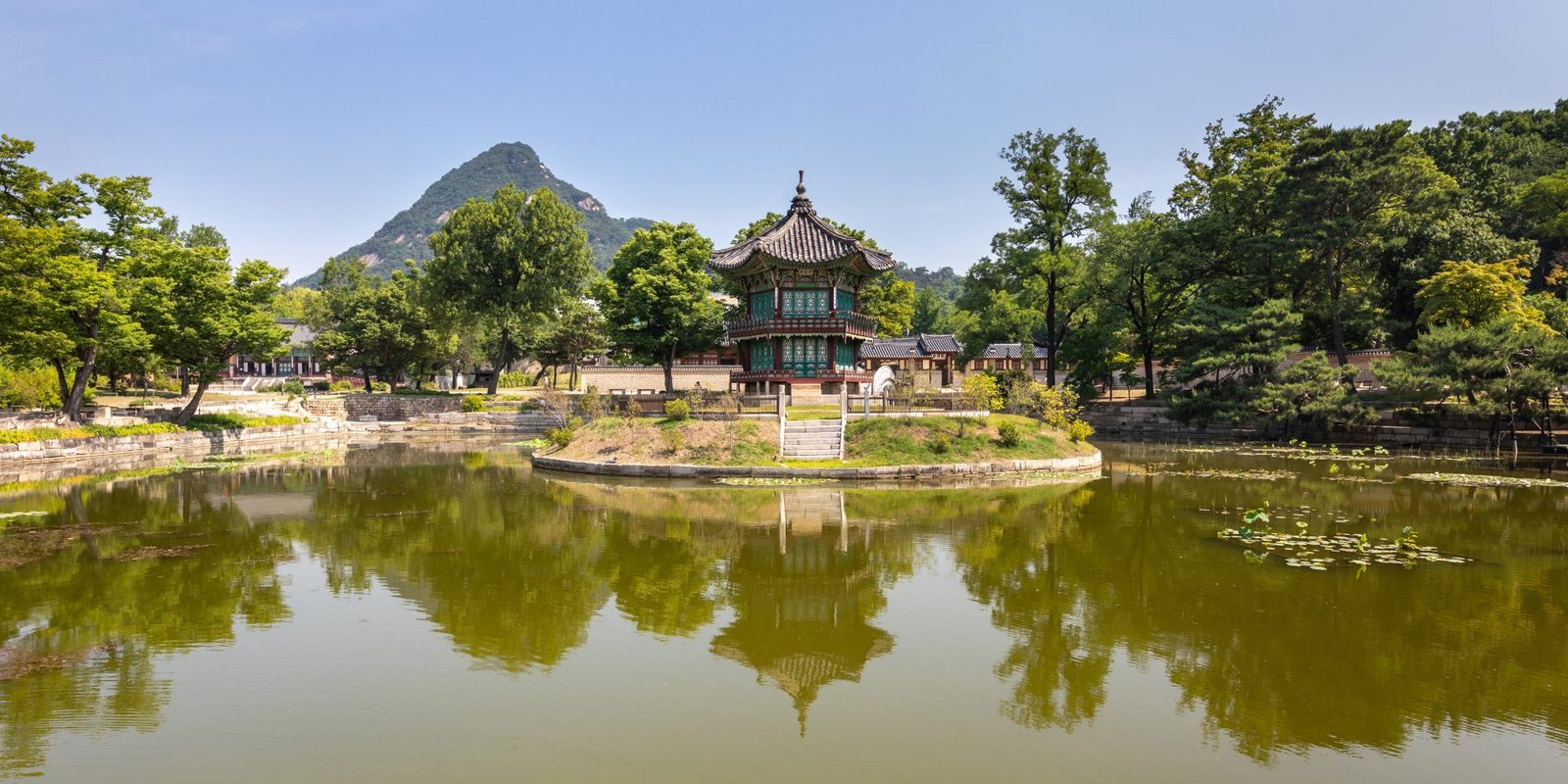
Photo: Panoramic view of Hyangwonjeong Pavilion in its pond at Gyeongbokgung Palace with blue sky in Seoul by Basile Morin, via Wikimedia Commons, CC BY-SA 4.0.