
In short
SRT ceased to exist on 1 September 2026 — KORAIL absorbed it, the trains became KTX, and fares fell about 10%. Seoul–Busan is now ₩54,400. The KORAIL PASS rarely pays: break-even is roughly ₩55,000 of travel per day. For Seoul, the Climate Card short-term passes (₩5,000 for one day) survive the scheme’s restructuring and beat single fares after about four rides.
Checked 27 August 2026 against Korean reporting of the merger, official KORAIL pass pricing and Seoul city fare tables.
On this page
On 1 September 2026, SRT stopped existing.
KORAIL absorbed SR Corporation, the SRT brand disappeared, its trains became KTX, and KTX fares were cut by an average of ten per cent to bring them down to the old SRT price level. Seoul to Busan fell from ₩59,800 to ₩54,400.
If you are reading an article that explains the difference between KTX and SRT and tells you which is cheaper, it was written before September 2026 and it is now wrong. Here is the current picture.
What the merger actually changed
The fares came down. Seoul–Busan is ₩54,400, and Yongsan to Gwangju Songjeong went from ₩46,800 to ₩42,000. The cut averages ten per cent and is being phased in over three years.
There are more trains. Weekday services went from 379 to 402 and weekend from 431 to 457 — about 116,000 extra seats a week.
Suseo is now a proper KTX station. Seoul’s high-speed departures split between Seoul Station and Yongsan in the centre, and Suseo in the south-east, on subway Line 3. Suseo was SRT’s home; it now gets full 955-seat KTX formations, new routings via Seodaejeon and Gupo, and — for the first time — mileage accrual and a 30 per cent discount on connecting conventional trains.
Practical consequence: if you are staying in Gangnam or the south-east, check Suseo departures. They were previously a separate operator with a separate app and most visitors never saw them.
The rules got better too. From 1 September, changes are free from seven days before travel to seven days after, up to 30 minutes before departure. And delay compensation is now 50 per cent for 60–90 minutes, 75 per cent for 90–120, and a full refund beyond two hours.
The app changed. “Korail+” launched on 3 August 2026 and searches both Seoul Station and Suseo departures in one place. The older KorailTalk app still exists.
Booking, and the thing that actually goes wrong
The window is 30 days. Official channels are korail.com, the KorailTalk app and now Korail+.
The failure mode to know about: foreign cards. KorailTalk’s own app-store listing confirms English, Chinese and Japanese support, and its review corpus contains repeated complaints about payments failing with foreign-issued cards. This is the single most common problem visitors hit.
Three workarounds that do not depend on the app cooperating:
- Buy at a station counter with your passport. Reliable, slightly slower.
- Use a reseller — Klook, Trip.com and KKday take international cards cleanly and issue a QR or a collection code.
- Buy the KORAIL PASS through the official foreigner portal, if the maths works — and read the next section first, because it usually does not.
We should be honest that we could not verify one widely repeated claim: that booking requires a Korean phone number. The evidence we found supports the card problem, not the phone-number rule, and the sources asserting the latter are thin. Assume cards are the issue.
The KORAIL PASS, and why it probably is not worth it
Official 2026 prices:
| Pass | Adult | Youth (13–27) | Child (6–12) |
|---|---|---|---|
| 2-day select | ₩131,000 | ₩105,000 | ₩66,000 |
| 3-day consecutive | ₩165,000 | ₩132,000 | ₩83,000 |
| 4-day select | ₩234,000 | ₩187,000 | ₩117,000 |
| 5-day consecutive | ₩244,000 | ₩195,000 | ₩122,000 |
It is for foreign visitors only — Korean nationals cannot use it — and it excludes the subway and all metropolitan commuter rail. First-class seats carry a 50 per cent surcharge.
Now the arithmetic, using post-merger fares:
| Trip | Point to point | Cheapest pass | Verdict |
|---|---|---|---|
| Seoul → Busan → Seoul | ₩108,800 | ₩131,000 | Pass loses by ₩22,200 |
| Seoul → Busan → Seoul, plus Seoul → Gangneung → Seoul | ₩164,000 | ₩234,000 | Pass loses by ₩70,000 |
Break-even is roughly ₩55,000 of rail travel per pass day — a Seoul–Busan-length journey every single day of the pass. Almost no leisure itinerary does that, and the September fare cut made the pass worse, because point-to-point fares fell while pass prices did not.
Buy the pass only if you genuinely intend a long journey every day. Otherwise buy tickets.
One open question we could not resolve: whether the pass now covers ex-SRT departures from Suseo. It explicitly excluded SRT before; now that SRT is KTX, the exclusion is arguably moot — but nothing published says so. Ask at a KORAIL Travel Centre before you rely on it.
Transit cards
| Card | Cost | What it does |
|---|---|---|
| T-money | ₩3,000–5,000 | The default. Transit nationwide, plus convenience stores and taxis |
| WOWPASS | ₩5,000 | Prepaid debit plus T-money plus currency exchange. Top up in 16 currencies |
| M-Pass | ₩15,000–64,500 | Foreigner-only, 1–7 days, up to 20 rides a day on Seoul subway, buses and AREX all-stop |
| Climate Card | ₩3,000 card + pass | Seoul-only unlimited travel — see below |
The top-up trap. Official guidance states plainly that the Climate Card can only be bought and charged with cash or a Korean-issued card. Reports that plain T-money kiosks now take foreign cards exist but we could not corroborate them.
So: carry cash for top-ups, or use WOWPASS, which is explicitly built around foreign payment instruments and lets you load it in your own currency.
The Climate Card, and the bit that is ending
Seoul’s flat-rate unlimited pass is excellent value for visitors and it is being restructured — but the tourist version survives.
| Short-term pass | Price |
|---|---|
| 1 day | ₩5,000 |
| 2 days | ₩8,000 |
| 3 days | ₩10,000 |
| 5 days | ₩15,000 |
| 7 days | ₩20,000 |
Against a ₩1,550 base subway fare, the one-day pass breaks even at about four rides and the seven-day at about thirteen across a week. A normal sightseeing day beats that comfortably.
What ended: the 30-day version stopped being sold on 1 September 2026, replaced by a national reimbursement scheme that requires a Korean bank account and is therefore useless to visitors. The 1-, 2-, 3-, 5- and 7-day passes continue, and remain Seoul-only.
The physical card costs ₩3,000 and is sold at Seoul Metro station information centres — cash only. The mobile version is Android-only and needs a Korean bank card, so tourists want the physical card.
Two traps. It excludes GTX, airport buses, wide-area red buses and any non-Seoul-licensed bus. And if you board inside the coverage zone and get off outside it, the card is invalid and you are charged separately.
Subway and bus fares
Subway — the rise happened on 28 June 2025:
| Card | Single ticket | |
|---|---|---|
| Adult | ₩1,550 | ₩1,650 |
| Youth | ₩900 | ₩1,650 |
| Child | ₩550 | ₩550 |
Base fare covers 10 km, then +₩100 per 5 km to 50 km and +₩100 per 8 km beyond. Transfers are free within 30 minutes — 60 late at night — for up to five boardings, but only with a card. Single-use tickets carry a ₩500 refundable deposit.
Buses: trunk and branch ₩1,500, circular ₩1,400, village ₩1,200, wide-area red ₩3,000, and late-night “N” buses ₩2,500. There is a 20 per cent early-bird discount before 06:30 with a card. The N buses run after the subway stops and are genuinely useful.
Taxis: ₩4,800 for the first 1.6 km then ₩100 per 131 m; deluxe ₩7,000 for the first 3 km. A late-night surcharge applies from 22:00 to 04:00.
From Incheon Airport
| Option | Fare | Time |
|---|---|---|
| AREX Express, non-stop reserved | ₩13,000 | 43 min to T1, 51 to T2 |
| AREX all-stop commuter train | up to ₩5,350 | 59 / 66 min |
| Airport Limousine bus | ₩17,000 adult, ₩12,000 child | — |
| Taxi (flat international fare) | ₩70,000–95,000 | — |
The all-stop train is a quarter of the express price for about fifteen minutes more. Unless you are carrying a great deal or arriving exhausted, take it.
One change to know: since 5 March 2026, passengers boarding limousine buses at Terminal 2 must buy a ticket in advance at a counter or machine. Routes 6001, 6002 and 6015 at Terminal 1 remain first-come. Onboard, only cash or T-money is accepted — no credit cards.
Gimpo, the domestic airport, is on subway Lines 5 and 9, AREX, the Gimpo Goldline and the Seohae Line, at standard subway fares. Line 9 runs direct to Gangnam.
Buses and planes
Express buses are two networks with two booking sites — Kobus for express, txbus for intercity — and Seoul’s terminals split by direction: the Gyeongbu terminal serves the south-east, the adjoining Central City terminal serves the Jeolla provinces. Both sit at Express Bus Terminal station.
Seoul–Busan by bus runs about ₩23,600 standard or ₩28,600 premium in four to five hours, against ₩54,400 and two and a half hours by train. The bus saves ₩30,000 and costs you two and a half hours — a poor trade for most visitors. Where buses genuinely win is anywhere off the high-speed network: Sokcho, the Jeolla interior, Namhae.
Domestic flights really only make sense for Jeju, which has no rail link and where Gimpo–Jeju is the busiest air route in the world. Note the industry is consolidating: Korean Air completed its acquisition of Asiana in December 2024, the Asiana brand is expected to be fully absorbed by the end of 2026, and Jin Air, Air Busan and Air Seoul are merging into a single low-cost carrier.
GTX-A: do not plan around it
You will see the GTX-A express line described as open. It is two disconnected halves. Suseo–Dongtan opened in March 2024 and Unjeongjungang–Seoul Station in December 2024, but the link joining them has not opened, and targets of June and August 2026 both passed. Samseong station is deferred to 2028.
We found no announcement of a through-connection, and sources give anything from mid-2027 onward. Do not state an opening date, and do not route yourself through it.
What we could not verify
The Seoul–Daejeon fare, which no source we could reach would yield. Post-merger fares for any route other than Seoul–Busan and Yongsan–Gwangju — do not apply the ten per cent cut yourself and treat the result as a fare. Whether a Korean phone number is genuinely required to book. Whether the KORAIL PASS covers Suseo departures now. Whether foreign cards work at T-money kiosks. And express bus fares beyond Seoul–Busan.
Korean rail and transit information is unusually hard to verify from outside the country — operator fare tables are JavaScript-rendered or published as images, and several official sites block automated access entirely. Where we could not confirm something, we have said so rather than filling the gap.
For where to base yourself, see our guide to where to stay in Seoul.
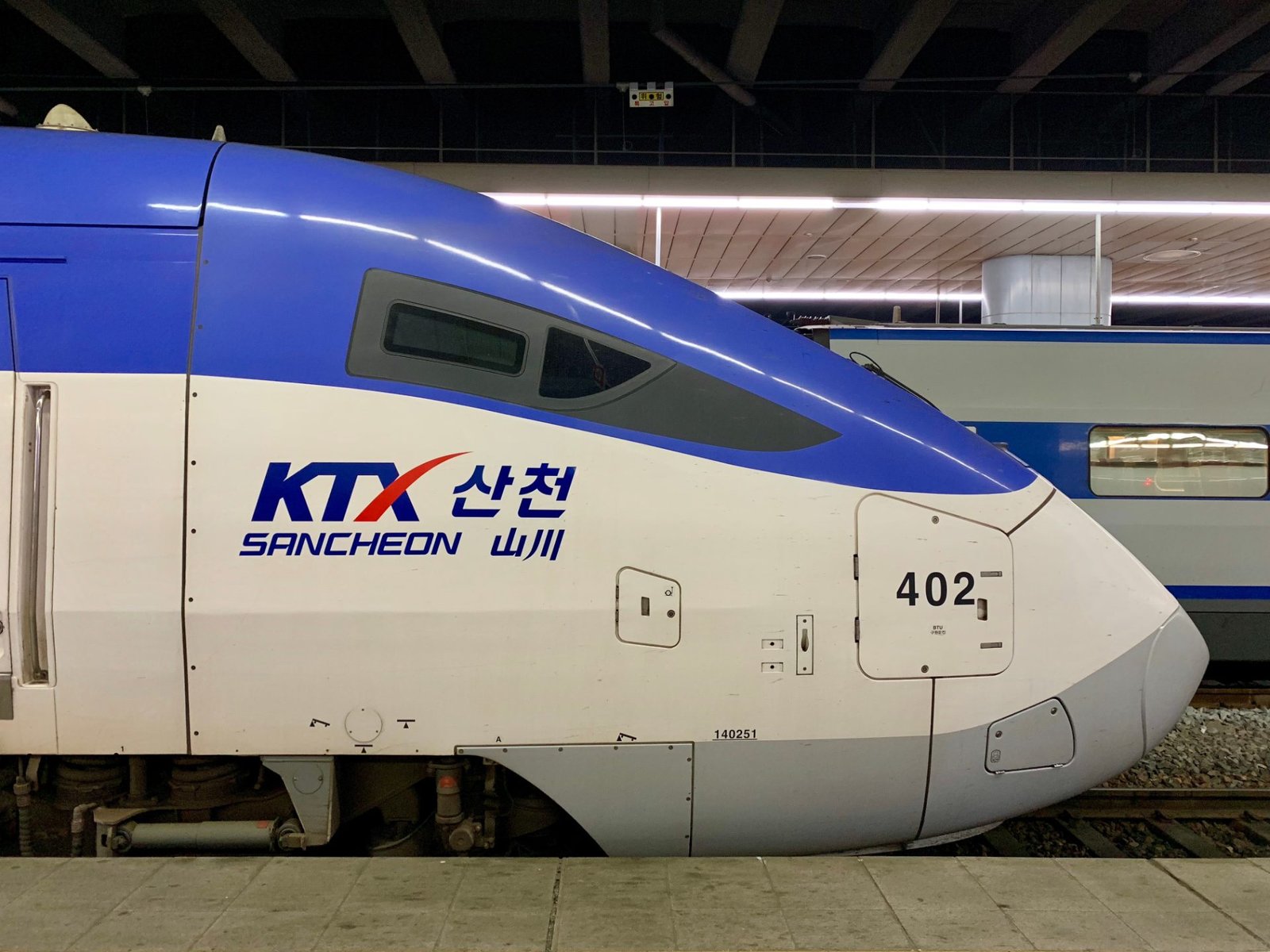
Photo: KTX Korea Train Express Seoul Station Seoul South Korea Republic of Korea ROK Daehan Minguk (31885863678) by bryan…, via Wikimedia Commons, CC BY-SA 2.0.