
In short
Registration is still required. You must be registered within three working days of arrival (weekends and public holidays do not count), and hotels do it for you automatically. If you stay in a private home you register yourself through the Emehmon system. Stays under three working days, and children under 16, need no registration at all.
Verified against Law ZRU-1074 and Cabinet Resolution No. 593 on lex.uz, 26 August 2026.
On this page
Almost everything written in English about registering as a visitor in Uzbekistan is wrong in at least one respect — and so is most of what four Western governments tell their own citizens. Here is what the law actually says, with the law.
The rule, from the statute
The governing instrument is Law ZRU-1074 of 10 July 2025, on the registration of citizens, foreign citizens and stateless persons at their place of residence and place of stay. It came into force on 12 October 2025.
Article 7, verbatim:
“Foreign citizens and stateless persons permanently residing in the territory of other states are obliged, no later than three working days from the day of their entry into the Republic of Uzbekistan, to register at their place of stay.”
Two details in that sentence undo most of what you have read.
It is three working days, not three days. The Russian is три рабочих дня. Arrive on a Friday evening and the clock does not run out on Monday.
The count starts from entry into the country, not from arrival at each new hotel. You are not restarting a three-day timer every time you change city.
Registration was not abolished
You may have seen headlines saying the obligation was lifted. It was not. What changed is the character of it.
Cabinet Resolution No. 35 of 30 January 2023 made registration notification-based rather than permission-based — you no longer need prior consent from internal-affairs bodies. The 2025 law put that on a statutory footing, and Presidential Resolution PP-14 of 19 January 2026 is digitising it further, with online filing through the unified government services portal by 1 September 2026.
PP-14 modernises registration. It does not remove it.
How you actually register
Under Cabinet Resolution No. 593 of 28 September 2020, still in force with amendments through 22 May 2026:
- Hotels and medical institutions register you themselves, on arrival, through the E-mehmon system. All four Western advisories agree on this, and they are right. If you are staying in hotels you will probably never think about it.
- A private host may register you through E-mehmon for stays up to 30 days. Beyond that they must apply to the regional Migration and Citizenship department within three working days.
- The 2025 law adds an online notification portal, E-xabar berish.
The State Committee for Tourism states that a tourist may register once in the E-mehmon system and travel to all cities of Uzbekistan — which is flatly incompatible with the unbroken-chain-of-hotel-slips model that dominates English guides.
Who does not need to register at all
Resolution 593 lists exemptions, and they are broader than almost anyone reports:
- Foreign citizens staying three days or less who leave within that period
- Tourists staying three days or less per location, with supporting documentation
- Minors under 16
- Organised tour groups whose itinerary is filed electronically
- Guided excursions of under 10 days outside populated areas
- Self-driving tourists in their own vehicles
- Transport crews, accredited diplomats, UN laissez-passer holders
Camping is covered explicitly by the tourism committee: independent travellers who spend the night in a vehicle or in tents register themselves through E-mehmon, with help from accommodation staff.
Overnight trains are the gap. Neither the law nor Resolution 593 mentions a night on a train, either as a registrable stay or as an exemption. The nearest applicable rule is the general three-days-or-less exemption. We are not going to extrapolate from that, and neither should anyone else.
The fines are not what you have been told
The penalty sits in Article 225 of the Code of Administrative Responsibility, and it is a banded scale, not a daily accrual:
| Length of violation | Penalty |
|---|---|
| Up to 10 days | 5 BRV |
| 11–30 days | 10 BRV |
| Over 30 days | 20 BRV |
BRV is the basic calculation unit — 412,000 som until 31 August 2026, rising to 440,000 som from 1 September 2026 under Presidential Decree UP-115 of 23 June 2026.
So the current registration penalty runs to roughly $175 to $350.
That scale was reduced, not raised. Law No. 579 of 5 November 2019 repealed Criminal Code Article 224, which had carried up to three years’ imprisonment for repeat violations, and cut the fines on hosts from 20–150 BRV to a flat 20 BRV. Anyone under 18 was exempted from sanction entirely.
And a further rise has failed, for now. A bill raising Article 225 to a fixed 30 BRV, and 40 BRV on repeat within a year, was returned for revision by the Legislative Chamber of the Oliy Majlis on 11 August 2026 — deputies objected that fixed penalties were disproportionate. As things stand, the 5–10 BRV scale is what applies.
What four governments tell their citizens, and what each gets wrong
| Advisory | What it says | The problem |
|---|---|---|
| UK, FCDO | Register with the local OVIR within 3 days; “a fine for each day that is missing or late” | Two errors. OVIR is not the registering body any more. And the fine is banded, not daily |
| US State Department | Register within 3 days of arriving | Understates it — the law says three working days |
| Canada | Register if staying more than 3 days; hotels normally do it at check-in | Closest to correct, and the only one reflecting the three-day exemption |
| Australia, Smartraveller | 3 or more days, “weekend days included” | The direct contradiction. The statute counts working days |
| US Embassy Tashkent | Fines “$1,000 to $12,000” | Sourced to November 2008, and rests on the criminal provision repealed in 2019 |
The US Embassy page is the worst of them. It still names the registering body as the “Office of Entry, Exit and Citizenship”, quotes a fine range roughly thirty times the real one, and rests on a criminal article that has not existed for nearly seven years.
The pattern worth knowing
There is a second-order lesson here that applies to more than registration.
Uzbekistan’s own outward-facing pages lag its own decrees. The Ministry of Foreign Affairs visa page carries an update stamp of 6 March 2025 and does not reflect the November 2025 decree that made US citizens visa-free. The embassy in Washington still describes the pre-2026 regime. A summary page on the government portal renders the cash-declaration threshold with digits reading one hundred million and words reading seventy million.
lex.uz, the legal database, is current. The ministry pages often are not. If you are checking a rule for yourself, that is where to check it.
What we could not verify
- The full text of Article 225, from the statute itself. The Code loads on lex.uz but the article body did not render; the 5–10 BRV scale here is reported from Uzbek legal and news publishers, not from the code.
- Which earlier acts ZRU-1074 repeals. Article 27 renders as a heading only, so we cannot confirm by repeal-check that Resolution 593’s exemption list survives intact — though lex.uz shows 593 as amended through 22 May 2026, which implies it does.
- Whether a night on an overnight train counts. No provision found anywhere.
- The passport-validity rule for visa-free arrivals specifically. The MFA gives six months from visa issuance, the FCDO tells British nationals three months beyond arrival; neither addresses visa-free entry directly.
Sources: Law ZRU-1074 and Cabinet Resolutions 593 and 66 on lex.uz, Presidential Decrees UP-203 and UP-115, Presidential Resolution PP-14, the State Committee for Tourism, and the current published advice of the UK, US, Canadian and Australian governments. All checked 26 August 2026.
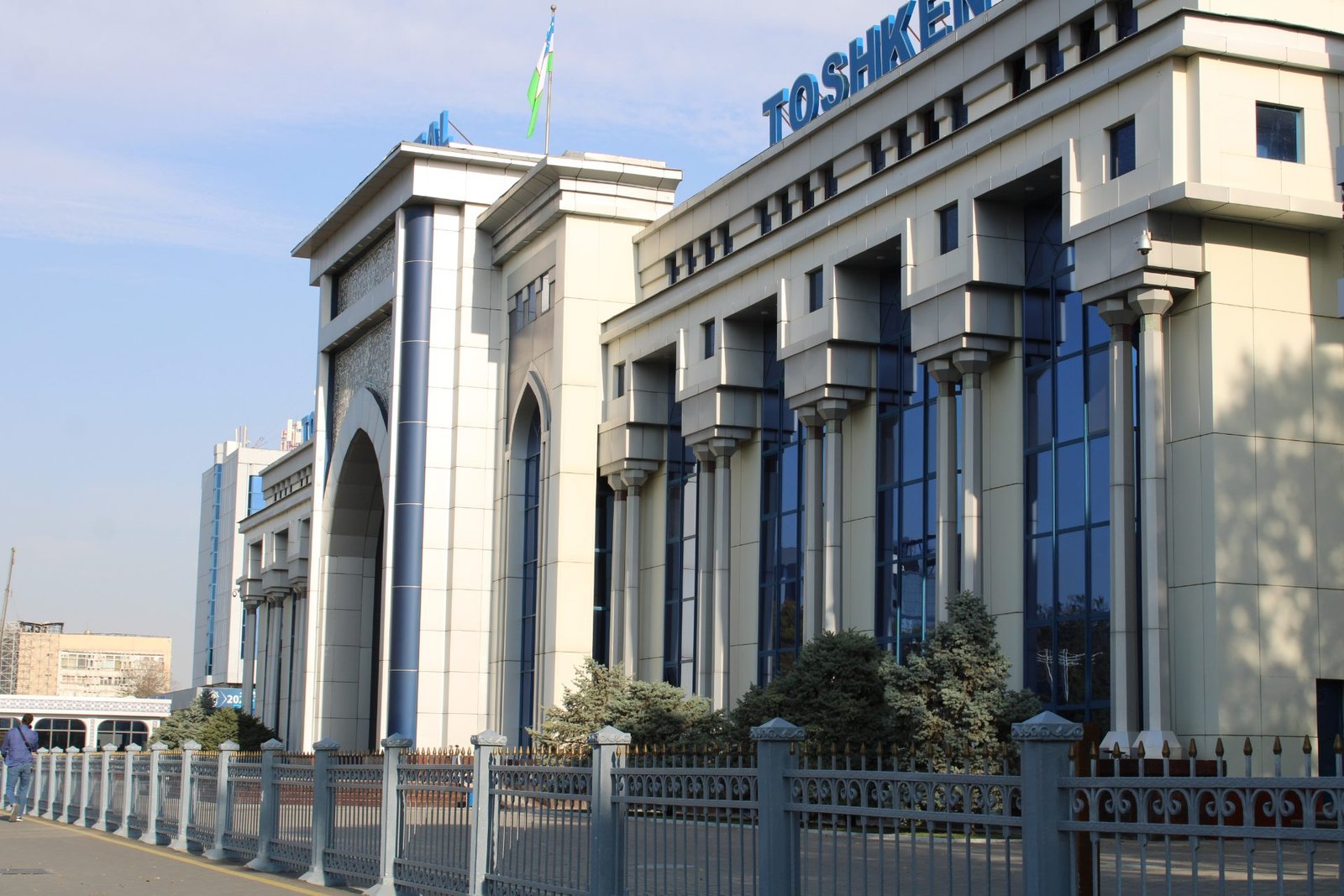
Photo: Temir yoʻl vokzali 27 by Humoyun Mehridinov, via Wikimedia Commons, CC BY-SA 4.0.