
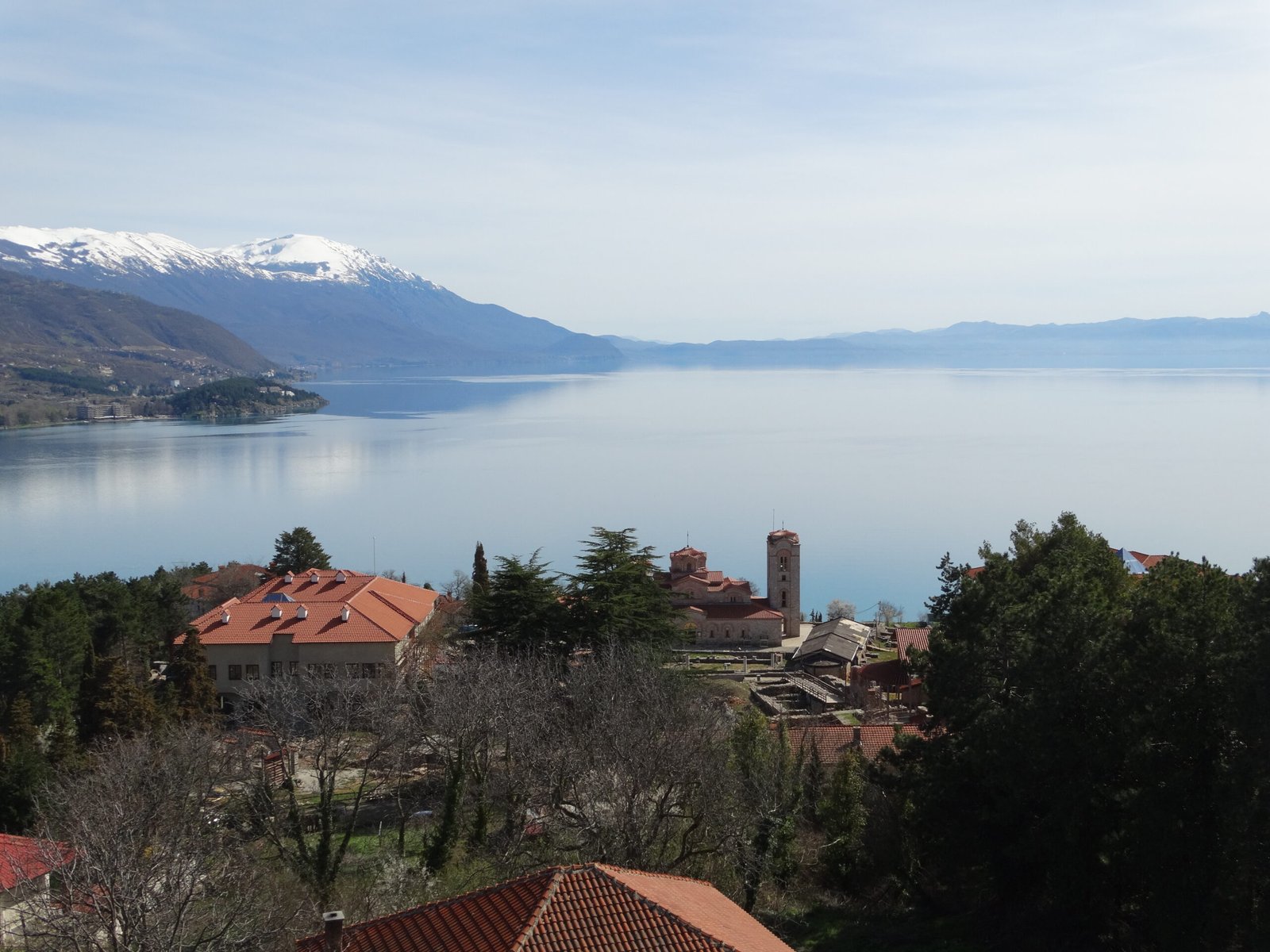
Ohrid holds a rare double UNESCO listing — for both its lake (one of Europe’s oldest and deepest, with endemic fish species) and its Old Town of Orthodox churches and monasteries — reached from Skopje in about 3 hours 20 minutes by direct bus. Its single most photographed sight, the whitewashed Church of St John at Kaneo, sits on a cliff above the water and is best seen at sunrise or sunset.
A double UNESCO site
Ohrid’s UNESCO designation protects two distinct things at once: the cultural heritage of its centuries of Orthodox churches and monasteries, and the natural significance of Lake Ohrid itself — one of the oldest and deepest lakes in Europe, home to endemic fish species found nowhere else.
Key sights
- Church of St John at Kaneo: Ohrid’s most photographed landmark, a small whitewashed church on a rocky cliff over the lake — best experienced at sunrise or sunset.
- Tsar Samuel’s Fortress: a hilltop fortress above the Old Town, a 15-30 minute uphill walk from the center; budget 1-1.5 hours to explore the ramparts and take in the panoramic views.
- The Old Town: narrow streets, historic churches and monasteries layered across centuries — simply wandering is a large part of the appeal.
Getting to Ohrid
Direct buses run from Skopje roughly 9 times daily between 06:30 and 19:30, taking about 3 hours 20 minutes and costing 950-980 MKD one-way (1,300-1,380 MKD return) — note this is meaningfully faster than some older estimates of 4-5 hours still circulating online. Two additional, slower services run via Bitola.
When to go
April-May and September-October offer the best combination of mild weather (roughly 15-18°C) and fewer crowds for sightseeing. Summer draws bigger crowds for lake swimming, since the water is genuinely warm enough to enjoy by June-August.
FAQ
How long does it take to get from Skopje to Ohrid?
About 3 hours 20 minutes by direct bus, with roughly 9 departures daily.
Why is Ohrid a UNESCO site?
For two reasons at once — its historic Orthodox churches and monasteries, and the lake’s exceptional age and endemic wildlife.
When’s the best time to see the Church of St John at Kaneo?
Sunrise or sunset, when the light on the whitewashed church and the cliff below is at its best.
Photo: Benoît Vicart, CC0, via Wikimedia Commons